Quick answer: To choose a foam product manufacturer in the USA, start with your application/desired final foam product, then confirm the supplier makes the right foam (EPS, GPS, or EPP) to the right standard, such as ASTM C578 for rigid polystyrene insulation. Next, verify their third-party quality verification, fabrication capabilities, freight radius, and lead times. Finally, get a quote that shows every cost driver: density, fabrication, tooling, and freight.
Picking a foam supplier looks simple until a load arrives undersized, under-density, or two weeks late. Foam is often a small line item, but it sits inside roofs, walls, precast panels, garage doors and cold-chain shipments, where a failure costs far more than the foam did.
This guide walks through what experienced buyers, specifiers and distributors actually check. It’s written for architects, contractors, precasters, OEMs and packaging engineers sourcing rigid foam, especially expanded polystyrene (EPS). New to the material? Start with our primer: What Is Expanded Polystyrene Foam?
Step 1: Define your application before you pick a foam
The application sets the performance targets: compressive strength, R-value, moisture exposure, fire assembly and dimensional tolerance. Those targets point to a material, and the material narrows your list of qualified manufacturers.
Three bead foams cover most rigid foam needs:
| Foam | What it is | Where it fits best |
| EPS (expanded polystyrene) | Rigid, closed-cell foam that is about 98% air; the most cost-effective insulation per R-value | Roofing, sheathing, EIFS, geofoam, precast, door cores, packaging, cold chain |
| GPS (graphite polystyrene) | EPS with graphite added to reflect and absorb radiant heat | Same uses as EPS where you need more R-value per inch, such as thinner walls or tighter cavities |
| EPP (expanded polypropylene) | Resilient, semi-flexible bead foam that recovers after impact | Reusable packaging, automotive and OEM parts, repeated-impact uses |
Here’s how common applications map to foam types, with links to each application page:
| Application | Foam options | Why it matters for supplier choice |
| Roofing | EPS | Needs code-compliant boards, tapered systems and fire-rated assembly support |
| Holey Board for LWIC roofs | EPS | Hole pattern must match the LWIC system spec, so cutting precision matters |
| Sheathing | EPS or GPS | Continuous insulation; ask about facers and code evaluations |
| EIFS | EPS or GPS | Tight flatness and squareness tolerances under finish coats |
| Geofoam | EPS | Specified by ASTM D6817 type; large volumes and freight planning |
| Precast | EPS or GPS | Insulated wall panels and void forms cut to shop drawings |
| Garage Door & Door Cores | EPS, GPS or EPP | High-volume, repeatable cores sized to the door line |
| Insulated Shipping Containers | EPS or GPS | Wall thickness and fit drive thermal hold time |
| Custom Packaging | EPS or EPP | Shape molding or fabrication to protect a specific product |
If you’re not sure which foam fits, a good manufacturer will tell you, including when a cheaper option will do. See all EPS applications for more detail.
Step 2: Verify specs, standards, and third-party verification
A credible manufacturer can tell you exactly which standard and type their product meets, and prove it. For rigid polystyrene insulation in the U.S., that standard is ASTM C578. It classifies EPS by type, with minimum density, compressive strength, and thermal resistance for each.
| ASTM C578 type | Min. density (pcf) | Min. compressive strength at 10% (psi) | Approx. R-value per inch at 75°F |
| Type XI | 0.70 | 5 | 3.1 |
| Type I | 0.90 | 10 | 3.6 |
| Type VIII | 1.15 | 13 | 3.8 |
| Type II | 1.35 | 15 | 4.0 |
| Type IX | 1.80 | 25 | 4.2 |
| Type XIV | 2.40 | 40 | 4.2 |
| Type XV | 2.85 | 60 | 4.3 |
Values summarized from ASTM C578; confirm against the current edition and the manufacturer’s data sheet.
Two practical takeaways. First, specify by type, not just “1 lb” or “2 lb” density. Type is what codes, roof assemblies, and engineers reference. Second, ask how the plant controls density from block to block, because a light block can miss the compressive strength the type requires.
Other standards to know:
- ASTM D6817 covers EPS geofoam, graded EPS12 through EPS46 by density. Geofoam buyers should specify by these grades. See our geofoam technical resource.
- Building code evaluations and listings. For roofing, sheathing and EIFS, ask for the evaluation reports and fire-assembly listings that cover the product in your assembly.
- Third-party quality verification. An independent agency audits production and samples product against the standard. Creative Foam Products is verified by RADCO / Twining Consulting.
Ask for current data sheets before you place an order, not after. Creative Foam keeps technical resources online, including EPS and sheathing specs.
Step 3: Evaluate molding and fabrication capabilities
Two plants can buy the same resin and ship very different parts. The difference is in how they mold and cut. How EPS is manufactured explains the full process; here’s what to ask about.
Molding: block vs. shape
- Block molding produces large blocks that are later cut into boards, tapered panels, and custom profiles. It suits construction products and short-run custom parts because it needs no part-specific tooling.
- Shape molding produces finished parts in a dedicated mold. It suits high-volume packaging and components, but tooling adds upfront cost and lead time.
Cutting and fabrication
- Hot-wire cutting is the workhorse for boards, tapers, and profiles. Ask what tolerances they hold on thickness, length, and squareness.
- CNC cutting handles complex 2D and 3D shapes and nests parts to reduce waste.
- Specialty equipment matters for some products. For example, Creative Foam cuts EPS Holey Board with a custom drill-press-style machine instead of hot wire, which avoids wire burn and misaligned holes that can weaken the bond in lightweight insulating concrete roofs.
- Laminating and facers turn plain EPS into sheathing or composite panels. Ask which facers they offer and whether the faced product carries its own evaluation.
- CAD layouts for tapered roof systems and precast parts show the supplier can work from your drawings.
For a closer look at cutting methods and why they affect edge quality, read How to Cut EPS Foam.
Ask to see sample parts cut to a spec like yours. A supplier proud of its fabrication will send them.
Step 4: Look at quality control, not just certificates
A certificate shows the product passed an audit. Daily quality control is what makes every load match it. Ask how the plant handles these points:
- Block aging. Freshly molded EPS blocks shrink slightly as blowing agent and moisture leave the cells. Blocks cut too soon can come out undersized or bowed. Ask how long blocks cure before cutting.
- Density checks. How often is each block weighed and measured, and what happens to a block that runs light?
- Dimensional inspection. Who checks thickness, flatness, and squareness, and against what tolerance?
- Labeling and traceability. Construction boards should carry labels showing type, manufacturer, and the verifying agency. Ask whether they can trace a board back to its production date.
- Documentation. Can they supply certificates of conformance and test data with an order when a project needs them?
Inspectors, roofing manufacturers, and precast engineers will ask for this paperwork. A supplier that has it ready saves you schedule time.
Step 5: Factor in location, freight, and lead times
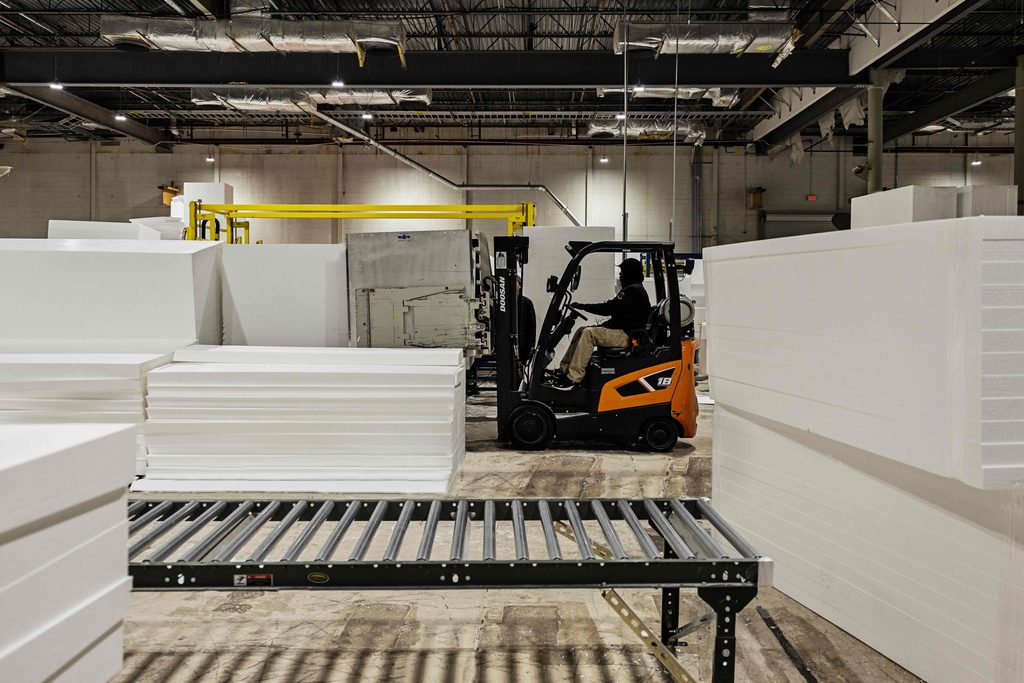
EPS is about 98% air, so a truckload fills up by volume long before it reaches its weight limit. Freight is often a large share of delivered cost, which makes the plant’s distance from your jobsite or dock a real buying factor.
Ask about:
- Plant location and shipping radius. A U.S. manufacturer within a practical trucking distance usually beats a cheaper quote from far away once freight is added.
- Load planning. Can they mix products on one truck, or nest parts to ship more per load?
- Lead times. Get standard lead times in writing, and ask how they handle rush orders.
- Stocking and JIT programs. For door cores, packaging and repeat construction products, scheduled releases keep your line or crew moving without tying up warehouse space.
- Packaging for transit. Corner protection and proper bundling prevent damaged edges on arrival.
Creative Foam Products manufactures in North Little Rock, Arkansas, and assigns regional contacts by state. Check the service area map to find yours.
Step 6: Understand how they sell, their sustainability record and their track record
How do they go to market? Some foam manufacturers sell direct; many construction products move through distributors. Neither is wrong, but you need to know who quotes, who holds stock and who answers when a load has a problem. Creative Foam sells mainly through distribution and works with architects, builders, installers, distributors and manufacturers.
Is the product responsible? EPS is 100% recyclable, and modern EPS is made without CFCs or HCFCs. Ask whether the supplier takes back clean scrap, uses recycled content where specs allow, and can support LEED documentation. The 2024 EPS Recycling Report covers industry recycling data.
Who stands behind them? Look past years in business to the relationships behind the plant:
- Industry memberships, such as the EPS Industry Alliance, the National Precast Concrete Association and the International Door Association
- Resin supply partnerships, which affect consistency and availability during shortages
- A team with hands-on experience in your market, whether roofing, siding, precast or packaging
Ask for references in your application. A supplier who has solved your problem before is worth more than a long client list. You can meet the Creative Foam team and review our certifications and memberships.
Step 7: Get a quote that shows what drives the price
The lowest unit price is not always the lowest delivered cost. Ask for a quote that breaks out each of these drivers:
| Cost driver | What moves it |
| Resin | Polystyrene resin tracks petrochemical markets, so prices can shift between quotes |
| Density / ASTM type | Higher types use more resin per board foot |
| Fabrication | Tapers, profiles, hole patterns, CNC work and lamination add machine time |
| Tooling | Shape-molded parts need a mold; ask who owns it and how it’s amortized |
| Freight | Billed by truck space, so distance and load efficiency matter |
| Volume and release schedule | Larger, predictable orders usually lower unit cost |
A good manufacturer will also suggest savings that don’t cut performance. That might mean a lower ASTM type where the load allows, a nested cut pattern, or a full-truck release schedule.
12 questions to ask a foam manufacturer before you order
- Where is the product manufactured, and how far is the plant from my site?
- Which ASTM C578 types (or D6817 grades) do you produce?
- Who provides your third-party verification, and can I see the current certificate?
- Can you send data sheets and evaluation reports for my application?
- Do you block mold, shape mold or both?
- What cutting equipment do you use, and what tolerances do you hold?
- How long do blocks age before cutting?
- Can you work from my drawings or CAD files?
- What are your standard lead times and minimum orders?
- Do you offer stocking, JIT or scheduled releases?
- Do you sell direct or through distributors in my area?
- Can you give references in my application?
Red flags
- They can’t name the ASTM type of the product they’re quoting.
- Data sheets are generic, old or missing.
- No independent verification, or they won’t share the certificate.
- The quote leaves out freight, tooling or fabrication.
- Lead times are vague, or change after the order is placed.
Work with a U.S. EPS manufacturer built around your spec
Creative Foam Products manufactures expanded polystyrene in North Little Rock, Arkansas, for building and construction, OEM and packaging customers. Our team came from the insulation, roofing, siding, and packaging industries, and we started the company after living through foam shortages ourselves.
That’s why we focus on what this guide covers: product made to ASTM C578, verified by RADCO, cut precisely to your drawings and delivered on schedule. Whether you need tapered roofing, precast inserts, door cores, or custom packaging, we’ll help you pick the right foam and type.
Contact Creative Foam Products for a quote, or call (501) 273-3626.